Showing posts with label edu. Show all posts

Monday, April 29, 2024

[fqndnuld] Debian all source

here are some scripts to download the sources for every package installed on your Debian or Ubuntu system, then track all the source code in a (typically) giant single git repository.

https://github.com/kenta2/debian-all-source

it has worked pretty well so far for Debian sid.

using git diff, you can view the source code changes made by package upgrades on your system.  unfortunately, the scripts work after you've upgraded; you can't preview source code changes before upgrading.

in an open-source system, although source code is theoretically available, most people never look at it because accessing it is usually a little complicated.  Debian does better than most with "apt-get source"; we've built on this.

seeing changes, often annotated with Changelog or NEWS file, helps understand code.

more commentary in the README.md file in the repository.

Sunday, December 17, 2023

[fgoqheap] education inducing more intelligent political debate

at great public cost (with more costs upcoming from student loan forgiveness), the U.S. has granted a lot of education to its populace.  conventional wisdom says one of the ways that such public investment in education pays off -- it becoming a public good benefitting the public beyond just the individuals receiving education -- is that education causes more intelligent political debate leading to better decisions made by democracy: if not through direct knowledge of the issues, then through the learned and practiced ability of critical thinking.

has this happened?  (cynically, no.)  how would one measure whether this has happened?  if it hasn't happened, what assumption in the conventional wisdom was wrong?  perhaps education doesn't teach critical thinking?  or democracy isn't designed to effectively use an educated or critical-thinking populace?  ("democracy is mob rule.")

[surjjhep] beginner chess

  1. checkmate opponent (mate in 1).
  2. avoid mate in 1.
  3. take opponent's free pieces.
  4. don't hang pieces.

beyond this, you are no longer a beginner.  tactics that win or lose, or win or lose material, over many moves are beyond beginner.  if you are a beginner, don't fret losing or losing material to more complex tactics.

this is equivalent to a chess engine at 2-ply depth and very simple evaluation function.  maybe 3-ply to determine "don't hang pieces".

can intermediate chess be similarly precisely defined?

beginner volleyball strategy: hit the ball over the net whenever you can, as soon as you can.

Friday, July 21, 2023

[yruasgsv] aesthetic sine and cosine

consider pedagogically defining sine and cosine as the prettiest oscillating functions.  figuring out how to construct the functions from this definition is left as an exercise for the student.

unlike the standard definitions which immediately invoke geometry, calculus, differential equations, complex numbers, or infinite series, often intimidating left-brain subjects, this definition asks for "pretty", a right-brain subject, an avenue of exploration that might be more appealing to some students.

or, "elegant".

perhaps the student will independently discover some intuitive form of the differential equation x'' = -x , or discover projecting circular motion onto a line, or discover "smooth", differentiable an infinite number of times, as a way of defining "pretty".

Wednesday, December 21, 2022

[eevwnawo] tower defense

desirable features for an entertaining tower defense game:

  1. kill attackers in varied and interesting ways -- sandbox style.
  2. attackers can be induced to kill each other.
  3. funnel attackers into to kill zones.
  4. mechanisms to separate attackers into types, which can then be killed efficiently in type-specific ways.
  5. no randomness

it feels a little like chemistry, refining materials.  perhaps a subset of real chemistry could be taught as a tower defense game.

to allow attackers to be killed in various ways, let an attacker be constructed out of many components.  a failure in any component kills the attacker: it has many single points of failure.

not only the defender's weapons or other attackers, but the environment can also be harnessed to kill attackers.

vaguely similar: build a better mousetrap.

Monday, June 20, 2022

[kjwijicq] C6 puzzle

part of the key idea at the core of the Kociemba algorithm for Rubik's cube is that the cyclic group over 4 items has as a subgroup the cyclic group over 2 items.

this suggests a puzzle which has interleaved cyclic groups over 6 items, with subgroups of 2 and 3 somehow making simpler puzzles.  devil in the details.

unfortunately, no polyhedron with all regular hexagon faces exists, so we need to be more clever.  perhaps some regular hexagon faces: several with this property exist among Archimedean solids, e.g., truncated tetrahedron, a Pyraminx without its tips.  the Skewb cross section of a cube a regular hexagon, though, in a Skewb, only 3 of the 6 rotations of the hexagon are used.  the regular hexagon tiling in a toroidal universe.

general idea is a puzzle which rewards understanding of group theory.  cyclic group of 6 might be too obvious to learn generalities.

Thursday, February 17, 2022

[zsetehtb] piano pedagogy

ways to teach or learn to play piano:

  1. classical, solo repertoire.  (very common path)
  2. as primarily an accompaniment instrument. mash out chords with a soloist playing another instrument.  (inspired by how piano is a rhythm instrument in jazz.)  if the soloist is a recording (this has become easier with modern technology), then this is "inverse karaoke".  or, soloist could be yourself, singing: maybe you've already learned the song singing with a recording.
  3. as a tool for learning music in general, especially for learning to compose, arrange, or improvise.  this route should stress breadth of repertoire over depth -- lots of easy songs and arrangements -- in order to learn and internalize common patterns in music, to learn a vocabulary.  ("easy" of course changes as you grow in skill.)

2 and 3 seem easier routes.  1 and 3 require thinking about and performing melody and accompaniment simultaneously.  this makes 1 more difficult but is helpful for 3, to learn how parts interact, how a whole song is constructed.

Sunday, August 15, 2021

[niufkaxx] gifts with credibly no strings attached

which grant organizations have established a good reputation of giving grants without strings attached?  assume pessimistically that strings are bad because they will inevitably get abused -- power corrupts -- even if the granting organization has good intentions.

where does "the government" fall on this reputation scale?  where should it fall?  inspiration was subidies (of many forms) and public funding for education, and how it might be (probably is being) used for political leverage, controlling what is taught, what is learned.

invisible strings might be tricky to discern.  for example, how a recipient uses a current grant, with seemingly no strings attached, might have consequences on eligiblity or success in receiving future grants.  grants and prizes that you can only win once can avoid this, but that's a very blunt method of avoiding this problem.

how should a granting organization operate, deciding on grant applications, to establish a good reputation of no strings attached, to avoid becoming corrupted by its own power?  regular turnover of people involved in making grant decisions might be one way.  similarly, avoid persistent structures or institutions within a granting institution having long term influence.  perhaps also blind applications: grant decision makers do not have access to identity of the applicant.

government "grants" in the form of higher minimum wage, and other similar regulations, perhaps lowered interest rates, might be interpretable as grants with few if any strings attached.  despite their problems (e.g., deadweight loss), perhaps their good of avoiding "power corrupts" outweighs their harms.

Thursday, May 20, 2021

[aiyakebx] Hawking radiation glitch

Hawking radiation is a frame-perfect, pixel-perfect exploit of a glitch in the game that is our universe.

the glitch exploits a weird interaction between the quantum mechanics and general relativity subroutines of the game.

a black hole event horizon is a chunk boundary, always a good place to look for glitches (which Hawking did).

theoretical physics is free to play.

inspired by speedrunners.

Thursday, April 29, 2021

[kowgxnvn] RPG with less magic

a role-playing game starts out with vast quantities of magic to maintain the world: a wizard did it.

by some mechanism, the magic decreases as the game progresses, and players explore building or maintaining a world that gets closer and closer to the Real World.

perhaps players will come up with innovative mechanisms that can be applied to the Real World.

more likely, the consequences of removing magic explain why the Real World is the way it is, perhaps why we can't have nice things.

Tuesday, October 13, 2020

[inpkrvco] Students interacting with each other

Most discussion of education, e.g., about improving it, focuses on the interaction between instructor and student (or, often even more narrowly, the unidirectional interaction of an instructor at students, filling a bucket).

However, anecdotally, a student's most lasting effects from education are often memories and other consequences of interacting with other students.

If the important part of education is nonetheless the interaction between instructor and student, we would expect education to be trying to prevent students from interacting with each other, to prevent distractions.  Other than, "Don't chat with other students while the instructor is lecturing", is it?  If so, how?

More likely, despite the lack of much discussion about it, society has recognized that students interacting with each other is an important part, perhaps the important part, of the education system, and the system has been designed, perhaps implicitly, to achieve something from the interaction of students with each other.  What is it achieving or trying to achieve?  How is it doing that?

Assume the main purpose of education is to allow signaling in the imperfect information game of high versus low productivity workers (Nobel Prize 2001).  A common way of enabling such signaling is to place hurdles in front of students.

Bullying, a form of students interacting with each other while in the education system, could be such a hurdle.  A bullied student typically suffers negative physical and especially psychological consequences.  Those consequences get reflected in decreased academic performance, signaling low productivity.  Were such bullied students destined to be low productivity workers even if they weren't bullied, that is, has bullying made hidden information visible?  Conversely, are students who survive bullying without much decreased academic performance, perhaps because they were not bullied, more likely to be high productivity?

This depends on what mechanisms determine which students get bullied and how much.  Obviously, this depends on school rules, enforcement, and various societal power structures.  However, one attractive general model of bullying is that it is an ancient human or animal instinct to identify then attack the weakest members of one's own herd, seeking to eliminate them to improve the overall strength of the herd.  Determining the weakest members is complicated, with hidden information everywhere, the same hidden information that the education system tries to make visible (assuming weak = low productivity, which is a big assumption).  Students figure out who to bully by interacting with each other, observing each other closely, something that administrators and instructors in the education system do not have the ability and resources to do.

Along that line of reasoning, students interacting with each other helps gather more information in the signaling game that is education.  Students interact with each other much more than an instructor can.  As they repeatedly interact, students gather more and more accurate information about each other, so such interaction can feed an information conduit for the education system to generate accurate signals.

For example, is there a student with whom other students do not want to work for a group project with groups formed voluntarily?  The other students may have knowledge, gathered through student interaction, knowledge not visible to the instructor, that the student is a low-productivity worker.  A group project, which such a student will therefore do poorly at, makes visible such hidden information.

There might be a feedback effect that obscures the signals generated through the mechanisms above.  For example, bullying causes a decrease in health (especially mental health), which causes more identification as a weak member of the herd (poor health = weak), which causes more bullying.  All the while, the bullying causes decreased academic performance, signaling low productivity.  How strong is this feedback effect?  Does it interfere with signaling so much that it makes the signals useless?  If not, why not?  Perhaps susceptibility to this feedback cycle is itself something usefully correlated with future productivity outside an educational environment, perhaps an indicator for ability to survive temporary adversity.  Or perhaps bullies accurately target the inherently weak instead of those just temporarily weak due to previous bullying.  Hypothesize that political efforts to decrease some forms of bullying happen only when this feedback effect interferes with signaling -- other forms of bullying will remain permitted.

These possibilities are pretty unpleasant to think about, perhaps taboo.  Society might outwardly condemn sinister practices such as bullying in schools, but at the same time secretly permit and endorse them (are group projects institutionalized bullying?) because they are effective at enabling the education system to be a signaling mechanism.

Inspired by the large amount of social-distancing remote education happening during COVID-19.  Students interact with each other much less.  Some students are complaining that remote education is not letting them adequately signal their ability.

Also inspired by anecdotes that dating, another form of students interacting with each other, while in the education system is awkward or difficult.  We may explore this further in a future post.

Wednesday, June 24, 2020

[xoyaoayd] Modern typewriter toy

Continuous feed paper from a roll.

Press a button to automatically type current date and time.

Of course, when you hit a regular letter key, the letter immediately gets printed on the paper, as a typewriter should do.

But also consider a line printer: a small display permits writing and editing one line, then a button commits the line of text to paper.

Additional buttons for TH, NG, AND.  Perhaps others.  Because a typewriter is always in typing mode, there's no danger of an accidental keystroke sending many characters to an application not expecting text to be typed.

Push a button to signal typing is done.  The typewriter then automatically appends a QR code version of what you've typed, so that what you typed can easily be scanned into digital form if desired.  Then, it automatically cuts the paper.

More toy-like features, intended for children: Large print (font).  This could especially be useful if the typist wants to leave a space to hand-draw an emoji.  Large-print keyboard.  Large keys.  Key layout ABC...Z, not QWERTY (but changeable).  Inspired by children being able to recognize letters before they can reliably write them by hand.

Freewrite is a vaguely similar product aimed for adults.  It does not provide the instant gratification of keystrokes being immediately committed to physical paper, though that's not its point.

Also vaguely similar, previously.

[lwfpegsf] Binary play dough

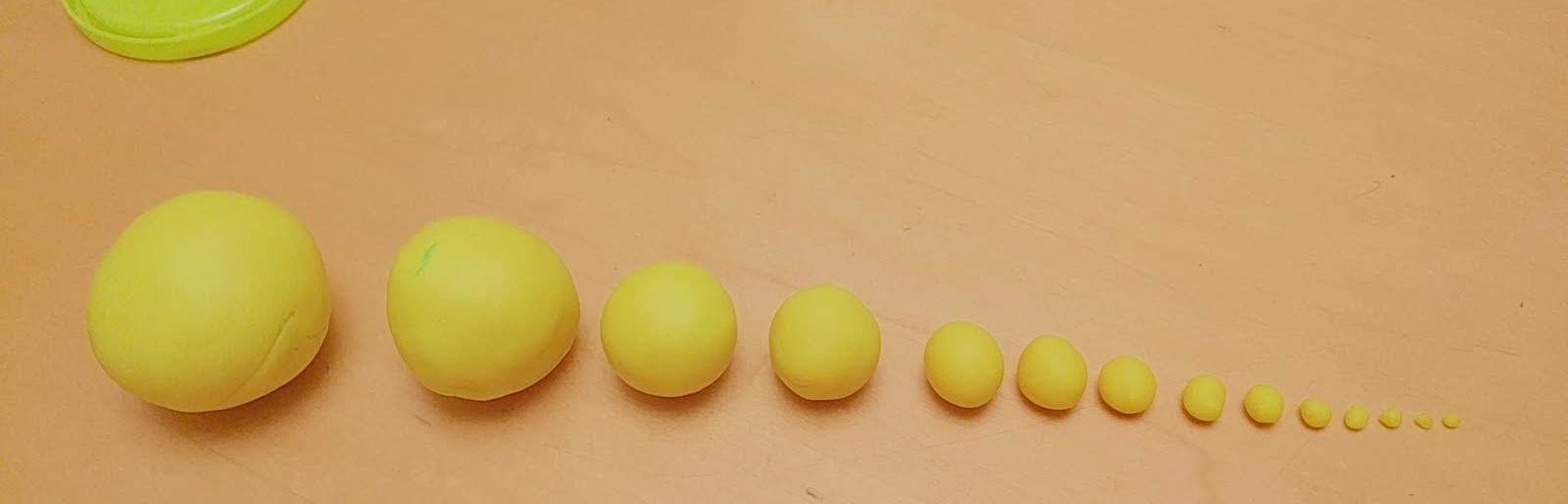
Take a lump of dough or clay and divide it in half.  Take one of the halves and divide it in half.  (Perhaps use a balance to divide precisely.)  How many times can you repeat?

Each lump, perhaps formed into a sphere, has linear dimensions 79.37% = (1/2)^(1/3) of the lump twice its size (volume).  Three halvings divide by 8, so you should a have a lump with half the linear dimensions.

Express numbers in binary as subsets of lumps.

play doh lumps of decreasing size

Wednesday, June 03, 2020

[ciapvjcg] Fun model of reality

Model reality, simplifying or complexifying the model until it is fun.  Abandon accuracy for the sake of fun.

Friday, May 08, 2020

[zqjjihpf] More compact CNF

Consider the following alternative way of expressing conjunctive normal form.  Omission of an operator indicates plus (disjunction).  Multiplication (conjunction) has weaker precedence.

ac̄e * ēgm̄ * mnā = (a OR not c OR e) AND (not e OR g OR not m) AND (m OR n OR not a)

(We use letters without ascenders acegmnopqrsuvwxyz as variables so there is space for the macron indicating negation.)

Conjunctive Normal Form, which is where all the fun is for Satisfiability, is a situation in which we wish the order of operations between plus and times, between OR and AND, had been established the other way.

This was inspired by "intelligence" tests which test the order of operations (operator precedence) for arithmetic.  We typically don't question why operator precedence is the way that it is, nor wonder if things could be better if precedence were different.

Wednesday, April 22, 2020

[hlqtcvan] Parrying the Death Star

While Luke, on board the Millennium Falcon, struggles against the combat remote under the tutelage of Obi-wan Kenobi, Darth Vader puts the Death Star through its paces by having it fire directly at himself, which he parries or tanks (absorbs) with the utmost of ease: the Death Star's power is insignificant next to the power of the Force.  (Do cinematic juxtaposition: both are spherical devices that shoot beams.)

While parrying, Vader takes engineering notes on the Death Star's beam, which is the point of the exercise: observe the beam first hand.  Anakin is a skillful engineer (he has been an engineer since a very young age when he was a slave to Watto) and is in fact one of the main forces (pun) behind the Death Star's construction.  It would have been nice if there were foreshadowing through the prequels that Anakin would become the engineering brains behind the construction of the Death Star.  (He would have been an awesome role model for young movie-watchers choosing to pursue a career in engineering.)  Maybe along the way, designs the combat droid that Luke later practices against.

The exercise allows testing the Death Star at full power against a target, while avoiding the attention that the explosion of a planet might attract.  Or, beyond full power as any engineer would likely try: let's keep cranking this baby up to see what its limits are: there's only one way to find out!

This testing is why the Empire did not fire on the gas giant planet Yavin, because they knew that the Death Star would have problems taking it out.  (On the other side of planet Yavin circled its moon Yavin IV, on which the Rebel base was constructed.  The Empire was forced to wait until the Death Star had a line of sight to Yavin IV.  This delay gave the Rebels just enough time to mount its attack against the Death Star's exhaust port.)

Saturday, October 26, 2019

[dvpmehdj] Hurdles and education salary

If the main purpose of education is to teach things, then that requires considerable skill on the part of the educator.

If the main purpose of education is to place hurdles in front of students so that those who clear them can signal (in an imperfect-information game) that they possess the ability to jump over hurdles (perhaps through high self-qi), then that is less difficult for the educator: a large variety of hurdles are equally effective at this kind of signaling.

Hypothesize that the wages earned by educators reflects the skill required or not required, and therefore their purpose in the education system.  That is, we can "read off" an educator's purpose (teaching or setting hurdles) simply by looking at their salary.

Counterarguments:

Teaching useful basic skills is easy because of the simpleness of the skill and people's innate (perhaps self-motivated) ability to learn, and because of this, educators of basic skills have low salaries.  Primary school teachers earning very little would be an instance of this counterexample.  Meanwhile, setting hurdles is difficult because there needs to be considerable infrastructure to prevent students from cheating.

Business school professors typically have high salaries (I think) among educators, but the observation that all they do is enable signaling in an imperfect information game uncontroversially won a Nobel Prize (2001).

Saturday, August 03, 2019

[rvzduqoc] Free speech versus political skepticism

In a regime which does a lot of censorship, people will suspect censorship is happening even in situations in which it is not:

  • They're suppressing the truth about the harmfulness of vaccines.
  • My favorite (fringe) news site reports truths which are being suppressed by the fake news that is mainstream media.

Hypothesize that one can measure the amount of censorship going on elsewhere in society by measuring the degree to which people believe stuff like the above.

Then, despite Constitutionally protected free speech and free press, America must have a lot of censorship going on.  Hypothesize that it's non-governmental censorship mechanisms like political correctness.

It also suggests what must be done to counter anti-vaxx movements: increase free speech generally.  Though achieving that might require something deeper.

Wednesday, July 17, 2019

[xkttocdn] Fish

Give a man a nuclear arsenal and he'll annihilate civilization for a day.  Teach a man how to build nuclear weapons and... something something something.

Maybe "a species" instead of "a man", definitely violating the Prime Directive.  Tell the story of a space traveler who travels from world to world teaching its inhabitants how to build nukes just to trollishly see what they do with them: they are truly a destroyer of worlds.

Perhaps our earth has been the victim of such trolling, in which case, we should search for the hidden cameras through which the aliens are watching, gleefully hoping to see us descend into mayhem and destruction.  The hidden cameras might be powerful telescopes many light years away.

Original inspiration: An attempt to be more extreme than "Set a man on fire and he'll be warm for the rest of his life."

Maybe something about being warm for the rest of the half-lives of the nuclear fuel or fallout.

Friday, June 28, 2019

[hiurqved] Numeric types with more errors

We consider a library of numeric types intended to be pedagogically useful -- so performance is not important.  We enumerate some conditions in which operations should result in exceptions.  We list here more error conditions than typically implemented.

Of course, division by zero.

For the integer type, an exception should occur if division does not come out evenly (so has a remainder). Of course, a separate truncating or rounding division operation is also available if you explicitly want to ignore a remainder.  Which way does it round?  Perhaps division by a negative number is not permitted unless it divides cleanly, or not permitted at all.

Exponentiation of a non-negative number by a rational number can come out evenly to an integer or rational.  Exception if the result is non-integer or irrational.

Similarly for logarithms with an integer or rational base.

It might be number theoretically tricky to decide when these operations come out even.

We definitely do not want NaN, Inf, precision underflow, integer wraparound including two's complement (which becomes visible when casting to an unsigned integer type).  It's shocking that machine types with these crazy features are the numeric types that beginners typically have to learn to program with.  These are annoyances that you should only later learn to put up with when you start caring about performance.