Devise a way to run iPhone programs on a device that is not an iPhone. What laws, for example, exactly which provisions of the DMCA, need to be changed?
And buy apps.
Devise a way to run iPhone programs on a device that is not an iPhone. What laws, for example, exactly which provisions of the DMCA, need to be changed?
And buy apps.
Combine road map information with elevation information to plan routes that avoid hills, or conserve energy (it's a waste of energy to go up a hill, then back down it, if you could have gone around). Bicyclists will appreciate this.
Do any web comics publish in a vector format (e.g., SVG, Postscript or PDF)? This could be the killer app that causes browser support and popular deployment. People love reading their web comics.
I recently saw a red design on a black shirt illuminated by green and blue LEDs.
The red completely disappeared into black on black and only the difference in textures could be seen. I wonder if this effect can be exploited.
Connecting the Phosphor X screensaver to the from Fark RSS feed is very nice. We use xscreensaver-demo to set up Text Manipulation in the Advanced tab to use the URL http://www.fark.com.nyud.net/feed.rss (We use Coral to avoid pounding the website.) I've also modified /usr/share/applications/screensavers/phosphor.desktop to
Exec=phosphor -root -scale 3 -ticks 2 -delay 120000 -fn -adobe-courier-bold-r-normal--34-240-100-100-m-200-iso8859-1
It would be an interesting curiosity, probably not practically useful, to create a locking keypad that does challenge-response. Along with a regular 10-digit keypad, it also has a display for a (say) 5 digit number. We might have the display polarized or hooded so only the person operating the lock can read it. The display displays a nonce, a "challenge". The user uses his private secret to calculate the response to the challenge and types it into the keypad. The door checks the answer using the user's public key.
If the lock is reverse engineered, you still cannot learn the user's private key.
This would be a great idea if only people could do modular exponentiation in their head.
This has probably already been done. Create a detailed map of the world assuming the ice caps melt. Where would be submerged, and how many feet under water?
Is there a correlation between cat ownership and participating in "touchy feely" partner dances such as contact improv, blues, and tango? Toxoplasmosis communicated by cat feces is thought to trigger touchy feely feelings in humans.
There is an alternate common cause: people who have disposable income and spare time pursue a hobby such as dancing or take care of a cat.
The world wants a tiling and compositing window manager, to be able to rescale a window to the size of the tile.
It should be easy to manufacture a bicycle helmet with LEDs embedded in it that blink and serve as bike lights. Plus, the helmet is high compared to the rest of the bike so is more likely to be seen in traffic, much like the center high mounted stop lamp in cars.
Create a game such that extremely complicated strategies do well (at least in the short run), and the game's overall behavior is chaotic in the face of such strategies.
We wish to mimic our finance system, with its complicated strategies in for example hedge funds and algorithmic trading and overall highly volatile behavior with booms and busts. What are the essential features of the finance system that make it behave the way it does?
Do the rules of the game necessarily have to be complicated? Wolfram's thesis is that you can get complicated behavior out of simple systems. But perhaps he is wrong in this case and the complexity of the financial markets, especially in how the value of something (usually compared to something else) reflects the complexity of the world it is embedded in.
Now that humans have broken the sound barrier, the next speed a human being (not a microscopic particle) has yet to achieve is the speed of light. There are many ways to interpret "breaking the speed of light", here arranged in roughly decreasing order of difficulty:
Absolutely exceeding the speed of light in flat spacetime. This requires disproving Einstein's theory of special relativity.
Using some quirk of general relativity and curved spacetime to exceed the speed of light as perceived by a stationary observer. In science fiction, these techniques go by names such as wormholes and warp fields.
Exceed the speed of light in air. It will take months of acceleration and a lot of airspace. The outward centrifugal force while flying around the planet might be too much for a human to bear.
Exceed the speed of light as perceived by the traveler, using a distance measured in the stationary reference, and time measured in the traveler's reference frame. This is cheating because of time dilation but nevertheless a great challenge. I think the threshold is about 70.7% of the speed of light.
Exceed the speed of light in water.
Exceed the speed of light in a specially prepared medium whose speed of light is very slow. This could be even done under human power.
Has any self-powered human broken the sound barrier in any medium?
Multitouch handheld devices these days, all which have sound out, may be an interesting device to develop a new musical instrument. They have enough degrees of freedom. The low-hanging fruit is some sort of ambient drone generator for electronic music.
Tangentially. Most, if not all, musical instruments are a combination of discrete and continuous (digital and analog) tactile interfaces. For trombone, the discreteness is hidden in the lip harmonics.
Piano keys have a great degree of different responses depending on the "touch", or the velocity of pushing down the key. Harpsichords do not, however. They are entirely discrete, and not too popular an instrument.
We assume the "will of the Force" is a vector field in some astral plane whose every point represents a state of the universe. A Jedi casts a vector from the current state whose direction is how he or she wishes to change the state of the universe. The magnitude of the Jedi's vector represents the Jedi's skill with the Force. A stronger Jedi can accomplish more with the Force.
The outcome of any Jedi's attempt to use the Force is the projection of the will of the Force vector onto the Jedi's vector, that is, the dot product. A Jedi who wishes to perform an action that coincides well with the will of the Force will be able to accomplish more than an action that is orthogonal to the will of the Force. This explains why a Jedi is much stronger some times than other times.
An interesting thing about the dot product is that if the Jedi's vector is exactly opposite (coincident but pointing the opposite direction) the will of the Force, the projection will also be strong. This is the Dark Side of the Force.
A Jedi's training allows him or her to sense the vector field will of the Force. With great power comes great responsibility, hence the importance of training to sense and go the Light direction of the will of the Force.
The Jedi philosopher asks, why does the Force point the direction that it does? What is it leading up towards?
Many people do not get tested for HIV because they fear a positive result for the incurable disease. However the public probably benefits from people getting tested, in the hopes that people who know they are infected will change their behavior. Hence the advertising campaign to encourage people to get tested.
Another much weirder way to encourage people to get tested is to simply give people a payment with their test results. One might pay more for a positive result. This is very weird because it might encourage all sorts of perverse behaviors, like people getting tested over and over again although they know their result could not have changed. Nevertheless, is the public health benefit worth it?
PSA: regular corn syrup is high in glucose. High-fructose corn syrup has some of that glucose chemically changed into fructose, which humans perceive as sweeter.
Glucose metabolizes faster than fructose. (Glucose metabolizes faster than anything. ) And the monosaccharide fructose metabolizes faster than the disaccharide table sugar sucrose.
So for the same quick metabolization reasons that high-fructose corn syrup is worse for you than sucrose (e.g., sugar high), regular corn syrup is itself worse than high fructose corn syrup, per unit weight or per unit sweetness.
Although many other solutions to this problem exist, I have yet to see a device or other method into which you can plug in your computer's video out (and headphone out) and it will broadcast a low power digital signal to your fancy new HDTV with antenna. Latency will probably be bad, but it is suitable for watching video from your laptop.
The hashlife algorithm when applied to cellular automata such as Conway's Game Of Life or Paterson's worm yields spectacular results: fast forwarding at exponential speed to calculate the exact state of the universe.
Could hashlife be applied to real computing? Several ideas: to speed up the boot process, a compiler optimization, a data structure and algorithm library.
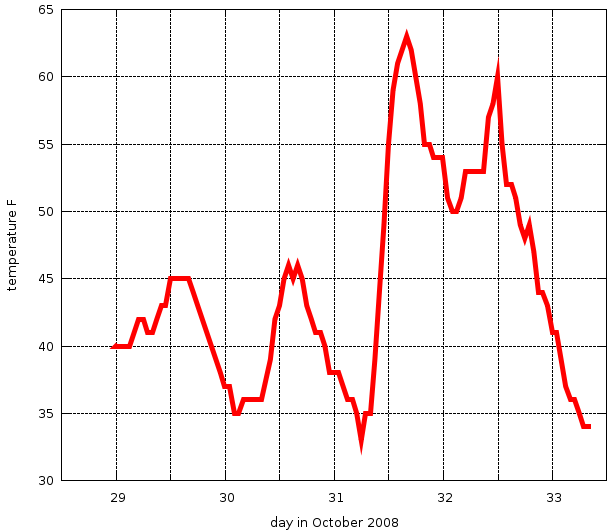
October 32 = November 1, etc. EDT
The afternoon and evening of October 31, 2008 in Boston were unseasonally warm, but for one day only.
It is unfortunate that we do not have a warm-weather costume holiday. Carnival occurs in the middle of summer in Rio in the southern hemisphere.
dd if=/dev/urandom of=foo bs=1M count=100000
100000+0 records in
100000+0 records out
104857600000 bytes (105 GB) copied, 30104.4 s, 3.5 MB/s
Write a faster not-cryptographic random generator.
Citizens lose their right to vote while incarcerated, and for some crimes permanently even after they have served their sentences. I worry that there is insufficient feedback in our lawmaking because everyone who disagrees with a law (enough to break it) ends up losing their right to vote and effect change in the law. America has a bulging disenfranchised prison population, which suffers from the "Out of sight, out of mind" problem (we don't see the overcrowded prisons, so we don't feel the need to fix them). Giving prisoners back the right to vote is probably one of the more politically palatable ways for (indirectly) fixing the prison problem. We are not giving these despicable prisoners anything tangible (like spending money on prisons), but prisoners have nothing better to do all day, so there will probably be high voter turnout and politicians will have to listen to them.
This also eliminates the political tactic of an incumbent politician passing laws that putting all of his opponent's supporters in jail, preventing them from voting to oust him.
On one hand, one can simply strike evolution from the curriculum and replace it other science topics (not intelligent design!). There is practically an unlimited body of science available to teach. For example, teach more chemistry or physics instead. Kids these days don't get taught any quantum chromodynamics.
On the other hand, the evolution of antibiotic-resistant bacteria is probably one of the most important practical science lessons that children should learn, and will directly affect their actions when using antibiotics or antibacterial products. The story of human evolution which directly contradicts the Bible, the story of why we came to be how we are, is also vitally important. It gives an explanation, with predictive power, of why we humans act and think the way we do.
Is science education more importantly intended to teach how science works (curiosity and testing hypotheses by experiment), or teaching important scientific results that will be useful for your adult life?
An apparently Pareto-dominated change in social policy, in which some members are made worse off, and everyone else is unaffected may not actually be Pareto dominated if you consider the externality of Schadenfreude. Those who are directly unaffected may actually experience increased utility due to taking pleasure in others' misfortune.
(Technically, it might not be an externality.)
This idea was inspired about thinking why someone would vote to ban gay marriage in California. If the proposition should pass, they can take pleasure (in these otherwise hard economic and terrorizing times) in the unhappiness of gays who will be unable to marry.
Yes, this is horrible. But it is real, and if the government's job is to make people happy, it cannot be ignored.
(1-x)/x
How far you've yet to go as a multiple of how far you've already gone.
Take the OLD corpus and rank the words by frequency, omitting words that occurred less than some threshold. Do the same with the NEW corpus. Which words have changed in ranking the most? (Words not present in the OLD corpus are assigned rank N+1 where N is the last rank in the OLD corpus.)
Update: this doesn't seem to work so well. We need Fisher or Barnard's tests.
Create an unpowered device (or hand chargeable) with which a human can record data in a machine-readable form. A mechanical (not electric) typewriter qualifies, though one wonders if one can do "better" for some measure of that word: perhaps in portability. Fewer buttons? Pen and paper does not qualify, because handwriting recognition is not so good.
Inspired by World War II correspondent Ernie Pyle.
There are just a handful of UI settings I do want to save, and everything else should get blown away. Perhaps a start and stop script. Encrypted random password.
Simply right click on the offending image and choose "Unsee" from the contextual menu.
Of course, you can't do this, so it begs a solution to a very hard AI problem: create a browser extension that will protect you from "shock" images.
The initial steps have an escalating war quality: sites may use tables of images, plugins, or any number of techniques to conceal what image they have. But the browser will ultimately win because it has (should have) the final say in what pixels get delivered to the screen.
It's a hard artificial intelligence problem (though compactly describable) because it requires computer vision to parse what is going on in the picture, some higher semantic analysis to determine that a picture is potentially shocking, and some even more human interaction understanding that the image actually is shocking based on the user not expecting to be shown it.
Here is something mind bending.
Closed loops can be knotted (knot theory) in 3D. If the analogy is correct, closed 2D surfaces can be knotted in four dimensions: sphere, torus, Klein bottle, etc. (I think the Klein bottle may be constructed without self intersecting surfaces in 4D. )
Even more mindbendingly, these knotted surfaces can be unknotted in five dimensions. Closed loops in 3D may be unknotted in 4D.
Did your local or national government restrict pork from Mexico or the United States in response to swine flu, in particular, the name "swine"? If so, you should take a close look at how your government works, because this incident is a canary in a coal mine. Consultation with an expert would have informed your government that the name derives from genetic history of the virus, and is not because swine communicate the human disease.
If your government took actions against pork imports, there are two possible reasons, both common features of a bad government.
Your government is run by idiots. There is no channel for experts who are knowledgeable about a subject to advise government action. Your government will take more idiotic actions in the future, perhaps more drastically negatively affecting you.
Special interests have too much power in your government. A small special interest, perhaps domestic pork producers, has managed to subvert the best interests of the people to change government policy to their advantage. Other special interests will pass other policies, perhaps more sinister, in the future.
Why did the Big Bang explode? We assume that the laws of physics moments after the Big Bang are the same as the laws of physics now.
The volume of the universe was very small, and the density very high, certainly high enough to undergo gravitational collapse. Why didn't it?
Physicists attempt to recreate the conditions of the early universe in particle accelerators, however it useful to consider the ultimate atom smasher, one capable of creating arbitrarily high densities and temperatures: a black hole. In the process of collapsing to singularity, mass must pass through conditions similar to the early universe, including whatever it was that caused inflation. Why aren't black holes exploding like the big bang?
There must be another repulsive force, preventing a black hole from collapsing to singularity, or even to early universe densities. Its works only at extremely small distances, distances not encountered in normal matter densities away from black holes.
MIT's Moira mailing lists need a bit to mark a list permanently public and self-owned, so they cannot be taken over. They should also have their change history logged so vandalism can be undone. There are out-of-band methods for dealing with repeat vandals.
Snapshotting and journaling filesystems have the same problem: they need metadata about a transaction all the way from the application layer.
Which set of writes constitutes an atomic transaction? When should a snapshot be taken? What is the significance of the snapshot?
There are three types of scientific experiments.
From grade school, you form a hypothesis, and perform an experiments to confirm or reject the hypothesis.
You repeat an experiment previously performed by someone else, seeking to replicate their results. Although this type of experiment may seem less glamorous than the first type, it is in fact the heart of science, that methods should be published, and results replicable. IMHO, this is the category that most grade schoolers should do.
A variation on this second type is just to repeat the analysis of the results.
You identify an incompleteness in a theory and seek determine what happens in such a situation that the theory is unable to predict an outcome. This experiment is done ostensibly without a hypothesis. The outcome may be used to form future hypotheses and extend the incomplete theory. Much science is performed on this frontier, despite grade school instruction of the scientific method. It sometimes has a "Let's blow shit up because we can" feel to it.
Make it easy for users to know and download the last repository revision to pass the testsuite.
Still bleeding-edge, but a little more reliable than a completely untested "nightly build."
Hello, Firefox?
Create a digital photo album device with durability and longevity comparable to a traditional paper photo album.
This is very challenging. Paper photo albums can survive the shock of being dropped out of a plane, storage in sun baked heat or arctic cold for decades if not centuries, as well as getting wet for short periods of time.
The first priority is maintaining the integrity of the data: RAID, error-correcting codes, and solid state drives are possible technologies.
The next priority is to make sure the data may be offloaded and the pictures viewed. Redundancy. Built in display. Redundant connectors and sockets for every type of connection: external displays, USB, ethernet, radio, infrared, etc.
Lastly, some interface for organizing photographs.
Create a device with a bunch of USB (or firewire) sockets, which when multiple external hard drives (or even USB thumb drives) are plugged into them, the drives become a RAID array. Provide RAID niceties of rebuilding the array after a disk is lost, and expanding the size of the array if larger disks are inserted (one by one).
This could be done all in software with a USB hub.
The lack of consumer adoption of RAID despite apparent consumer demand for reliable storage appears to be the dearth of actually inexpensive disks. Perhaps the hardware overhead of a hard drive always makes them cost at least about $50,which when you multiply that by 2 or 5 depending on how many disks you want in your array, becomes quite a lot. And we want small form factor to fit a bunch of disks. Perhaps USB keys are the way.
Create a Firefox extension that lets you adjust the line spacing of the text of a webpage.
CSS
This should be easy.
Certainly the happiness of orgasm and the happiness of Schadenfreude are very different. Brain studies, fMRI and the like, could concretely identify and classify all the different types of happiness that our language and culture have conflated into one term. Perhaps true happiness is the appropriate balance of them all.
Some people feel they must keep a gun in the house for self-defense. However, there is the great danger of accidental discharge, especially by children. This danger from the possibility of accident is thought to exceed the danger of not having a gun. One can lock up the gun to make it difficult for children to access it, but that makes it also time-consuming for you to access it in the event that you need it quickly.
One solution is to roll back the killing technology one generation and reconsider keeping a knives, daggers, swords, etc. for self defense. Of course, children can hurt themselves with knives as well, but if you are worried about that, you need to keep them away from kitchen knives and scissors as well. Furthermore, in untrained hands like children, frequently knife accidents are not fatal.
We need two things: knives etc. specifically designed for combat against humans (most knives are either a tool for cutting stationary objects, or are ceremonial and expensive). I'm not sure what the optimal form factor should be: a dagger? a sword? a stick with a blade on the end? (But no doubt from the pre-firearm era a great amount of research exists answering that question.) We need training to use such a knife in combat (this training is the difference between you and the untrained hands of children).
Of course, a knife is a weaker weapon than a gun, and in contest the gun will probably win. But no matter what weapon you keep for self-defense, there is always another weapon more powerful that it will lose to.
In Japan, a country with strict gun control laws, most of the murders are stabbings, so a knife is "good enough".
A nanny state might enforce that any place that sells guns must also sell knives.
If the game of Go 囲碁 is played with passing forbidden, it eventually achieves Malthusian "equilibrium" where, after all the land is exhausted, all that remain are bad moves leading to mass death.
In the event of an apocalyptic scenario that the temperature of the earth should increase by a lot so that everything can ignite, (I blame alien invasion, though natural causes are possible) what would it be like? Fire-generated wind will probably be significant.
Art museums can provide a "set" with which you can synthesize having your picture taken with the art without actually having to disturb the art or other people. Using the power of computer graphics, you can even model secondary reflections. It's a best case scenario where all the parameters of the synthetic image can been measured in a controlled setting.
"Thank you Captain Exposition."
Consider a film, probably an action film, which consists of only the scenes that are good to film.
The rest of the story is in other media -- text, graphic novel, game.
Consider it a multimedia presentation.
One one hand, when you donate to charity, it should be to help others. On the other hand, you would like to spend your money to benefit yourself. It is possible to accomplish both of these goals simultaneously.
You need to donate to a "good" (in the economic sense) that your enjoyment of the good does not prevent others from enjoying the good, a nonrivalrous and nonexcludable good, that is, a public good (in the economic sense).
Unfortunately there are not a lot of opportunities to donate to public goods, and the ones that exist are weird. You can donate to science, especially to medical research, especially to medical research for a medical condition you may have a genetic, environmental, or lifestyle predilection of becoming afflicted. But frequently after the medical research is completed into a medical treatment, you have to pay for it again even though you donated toward it in the beginning.
For this and others, there's a dilution going on; your money is going to a very wide cause, and/or you don't know what you'll get out at the end: the end result of the medical research.
Public broadcasting, TV and radio over the air, is a pretty good example of a public good; though they don't let you earmark it toward specific shows or genres.
Now we propose other categories that I wish existed.
The most famous public good is information, because information, once created, can be infinitely copied allowing many people to enjoy it.
With much art being able to be digitally encoded, much art is information. Thus, it would be nice to donate toward creation of art to be placed in public domain after creation. Furthermore, it should be possible to donate toward a particular artist. In essence, "the public" commissions an artist, and "the public" receives the work - it being in public domain.
Examples of digitally encodable art are film, music, literature, digital images. With the power of 3D printing and CNC (?) some sculpture might be possible, too. Unfortunately not live performances, but documented choreography is.
The good thing about commissioning an artist is based on previous work, you have a pretty good idea of what you'll get out of the commission: most artists have a style that they stick to.
This is in fact a business model that may work for artists even with weak (or no) copyright protections. An artist establishes a collection box and a threshold, fans donate into collection box until the threshold is released, and then the musician records his or her next album or the producer/director makes his or her next film or the author writes his or her next book, releasing them into the public domain.
Another category of information is open source software. You can donate toward a project, or for a large project, you can donate toward a particular feature or bug you want fixed, a bug bounty.
Another category is consumer information. You can donate toward research about a particular product or service that you intend to buy. This is not donating toward a diluted consumer-research group in general, but toward the creation of research for a particular product or set of products you are choosing among. In our era of aggressive advertising to buy a product, there is often a dearth of information of why NOT to buy it.
The other famous category of public goods are infrastructure (though sometimes they are not completely nonrivalrous, like congestion on roads). Donate specifically for upkeep of the roads, sidewalks, and parks you use.
Because donations toward public goods offer the most bang for the buck, they ought to constitute the bulk of charitable donations, rather than mere wealth redistribution (which only offers $1 bang for $1) which seems to dominate today.
Consider a ratings difference of r = 70.83533779584746678944378491. In a single game, the expected score difference of two players with that difference is p = 1/(1+10^(r/400)) = 0.3994491169441985005619073685.
For a twelve-game match, the worse-rated player has a probability of sum(i=6, 12, binomial(12,i)*p^i*(1-p)^(12-i)) = 1/3 of a tie or "upset", scoring 6 or more points.
This is the basis of the simplest format of the chess world championship. Any player with a rating of within 70 points of the current champion may bid a prize fund to challenge. Whoever bids the highest (actually delivering the bid, of course), wins the right to challenge.
Hypothetically, an unscrupulous current champion might try to game the system by bankrolling a specific weaker player (whom he can beat, possibly in an arranged match) to become the challenger. However, this is where the alleged graft and corruption in FIDE actually does good: FIDE aggressively takes a cut, say 20%, of the prize fund (some of it is used to make sure the playing venue and conditions are fair, some of which might be used to fund youth and women's championshps), which means such a strategy is guaranteed to cost the current champion at least 20% of the winning bid which he bankrolled.
An additional mechanism prevent a single wealthy entity from corrupting the system for many years in a row (e.g., bankrolling a weak-ish challenger on behalf of the champion), we also allow to bid a group of candidates representing multiple sponsors who all pay in, and play a candidates tournament to select a final challenger. The details of the candidates tournament are worked out amongst themselves before the group bid. There are plenty of degrees of freedom.
I hope this doesn't make things worse, with the possibility of a cabal controlling the candidates process, excluding someone they don't like. It also opens the possibility of a sponsor getting back more than they invested, a gamble.
This was originally inspired by Topalov's 2700+money proposal.
